2026 VAR: 4 Referee Insights
Video Assistant Referee (VAR) is an officiating system in football that reviews match-changing decisions through multiple broadcast-quality camera angles, chiefly in competitions operating under the I...

2026 VAR: 4 Referee Insights
Video Assistant Referee (VAR) is an officiating system in football that reviews match-changing decisions through multiple broadcast-quality camera angles, chiefly in competitions operating under the International Football Association Board (IFAB) Laws of the Game. A VAR team checks every goal, penalty decision, direct-red-card incident, and mistaken-identity case, but it can recommend intervention only for a “clear and obvious error” or a serious missed incident. The on-field referee remains the final decision-maker, and the system has no fixed review time limit because accuracy outranks speed. FIFA, UEFA, and national leagues implement VAR under approved protocols, with technology such as semi-automated offside support where available. The practical takeaway is simple: when watching a 2026 match, separate the automatic check from the referee’s formal review; they are different stages with different authority.
Is VAR really designed to eliminate refereeing mistakes?
VAR is not designed to eliminate every refereeing mistake; it is designed to correct clear, match-changing errors in four defined categories: goals, penalties, direct red cards, and mistaken identity. The referee still makes the initial decision, while the video team supplies evidence only when intervention meets the IFAB threshold.
That distinction matters because football is not a laboratory with infinitely precise observations. A decision can be debatable without being demonstrably wrong, and VAR should not replace the referee merely because another angle produces a different interpretation. Under the IFAB Video Assistant Referee protocol, the original decision remains in force unless the review establishes a clear and obvious error or a serious missed incident. As IFAB states, “the final decision is always taken by the referee,” whether that decision follows a VAR recommendation or an on-field review.
The expected-value logic is straightforward: if a review has a high probability of correcting a decisive error and a low probability of disrupting a marginal call, intervention is rational. However, the system deliberately accepts some uncertainty to avoid turning every physical challenge into a forensic hearing. There is no appeal button for coaches, no player vote, and no requirement that every possible disagreement becomes a review. VAR automatically checks relevant incidents, which makes theatrical requests for a review functionally pointless.
Want a clearer framework for following match decisions? Goal Moments tracks tournament context, tactical consequences, and major officiating developments for FIFA World Cup audiences.
[Internal Link: FIFA World Cup match predictions]
How does VAR handle a goal or penalty decision?
For a goal or penalty decision, VAR checks the relevant attacking or defending sequence and communicates a recommendation only if video evidence indicates a clear and obvious error or a serious missed incident. The referee may accept the information without viewing the monitor for factual decisions, or conduct an on-field review when interpretation is required.
The process begins with the on-field referee making a decision, even if play continues. The VAR then checks the incident using available footage, replay speed, camera angle, and relevant law. For a goal, the review can examine an offside position, an attacking handball, a foul in the buildup, or whether the ball fully crossed the goal line. For a penalty, it can assess whether contact occurred inside the penalty area, whether the challenge was punishable, and whether the ball struck an arm under the applicable handball law.
A useful operational distinction is “check” versus “review.” A check is the silent or internal examination performed by the VAR team; a review is the formal process initiated by the referee. The VAR cannot overrule the referee, and players cannot demand a review. If the evidence is purely factual, such as a player’s position relative to an offside line, the referee may receive a recommendation without personally watching the replay. If the issue involves intent, force, or the threshold for a foul, an on-field review is normally more defensible.
- The referee makes the initial decision.
- The VAR team automatically checks the incident.
- The VAR recommends intervention only when the protocol threshold is met.
- The referee either accepts factual information or views the monitor.
- The referee announces the final decision and restart.
The most important practical insight is that a corrected goal may still leave later disciplinary events intact. If play continued after the incident, cautions or send-offs during that period are not automatically erased merely because the original goal or penalty decision changes. That rule prevents a review from creating a second, unrelated injustice.
See the decision categories in context before assessing a disputed match moment.
What about offside, handball, and other edge cases?
Offside and handball reviews are edge cases because technology can establish location or contact more reliably than it can determine the legal meaning of an action. Semi-automated offside technology may accelerate line construction and identify the relevant body parts, but the match officials still apply the Law and determine whether an offence affected play.
Offside is not judged by the attacker’s hands or arms, because those body parts cannot legally score a goal. The review instead considers the last playable moment, the second-last opponent, the ball, and the attacker’s eligible scoring body parts. A line may look mathematically exact on television, yet the result still depends on selecting the correct frame when the ball is played. This is why a one-frame difference can alter the apparent geometry, particularly when a passer’s foot is moving quickly.
Handball presents a different probability problem. Video can show contact, but contact alone does not automatically equal an offence. Officials consider the arm’s position, the player’s movement, distance, and whether the action made the body unnaturally bigger under the current Laws of the Game. Slow motion can exaggerate impact and obscure speed; therefore, normal-speed footage may be more informative for judging the character of a challenge.
A particularly overlooked edge case concerns a restart. Once play has been stopped and restarted, a review is generally unavailable, except for mistaken identity or serious sending-off offences involving conduct such as violent action, spitting, biting, or extremely offensive abuse. This creates a hard boundary: VAR is not an unlimited rewind system. The relevant review period is determined by the Laws and protocol, not by the emotional importance of the incident.
To explore how these details affect tournament outcomes, consult Goal Moments’ [Internal Link: World Cup team tactics analysis] and compare defensive line height with offside risk.
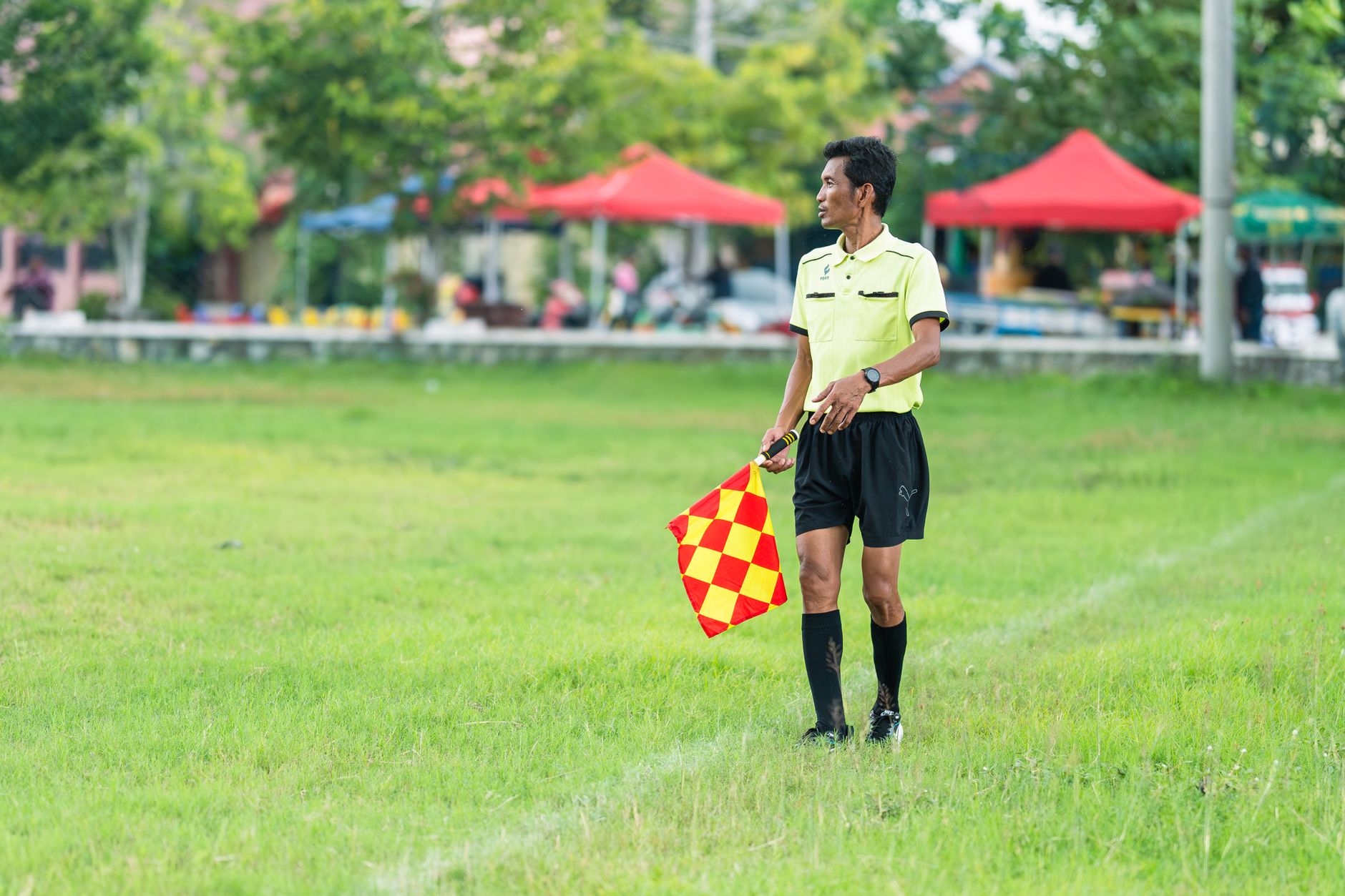
Photo by Sinan KRIYA on Pexels
Where does VAR fail?
VAR fails when camera evidence is incomplete, the incident is inherently interpretive, communication is unclear, or the delay costs more than the marginal accuracy gained. It also fails as a public expectation when supporters assume every controversial event must produce a correction, despite the protocol’s deliberately narrow intervention threshold.
The first limitation is data quality. A VAR team cannot recover an angle that was never captured, and a crowded view may not reveal whether contact occurred before or after the ball was played. The second limitation is framing: selecting the wrong instant can distort offside analysis, while excessive slow motion can make ordinary football contact appear reckless. The third limitation is law interpretation. Two trained officials can agree on the footage and still disagree about whether the evidence reaches the “clear and obvious” standard.
The fourth limitation is communication. IFAB requires the referee to remain visible during the review process, but a stadium audience may still wait without understanding what is being examined. That uncertainty creates a measurable reputational cost: even a correct decision can feel arbitrary when the explanation is insufficient. UEFA competitions and FIFA tournaments have increasingly used stadium announcements or referee communication practices to improve transparency, but disclosure cannot eliminate disagreement.
Here is the contrarian conclusion: VAR does not necessarily make football feel fairer after every decision. It improves the expected accuracy of selected high-impact decisions, while potentially reducing spontaneity and increasing stoppage time. That trade-off is rational if the objective is to correct a missed penalty or wrongly allowed goal; it is less attractive if applied to marginal contact with no decisive consequence. In other words, the system’s success should be measured by error correction per intervention, not by the number of replays shown on television.
- Strong use case: factual goal-line, offside, and mistaken-identity evidence.
- Moderate use case: penalty-area contact requiring contextual interpretation.
- Weak use case: minor fouls, subjective physical contact, and non-reviewable restarts.
- Persistent risk: treating every disagreement as proof of a clear error.
Want data-led tournament commentary rather than replay outrage? Follow Goal Moments for [Internal Link: player statistics and match-impact reports].
Should you try VAR today?
You should use VAR knowledge today as a viewing and analysis framework, not as a substitute for the referee’s authority or a guarantee of perfect outcomes. Before judging a decision, identify the review category, establish the original call, distinguish a factual question from an interpretive one, and ask whether the visible evidence actually reaches the clear-and-obvious threshold.
For supporters, analysts, and readers following the 2026 FIFA World Cup, the most efficient method is to record five facts: the match minute, the restart status, the original decision, the incident category, and the final decision. This prevents hindsight from contaminating the analysis. A goal disallowed for offside should not be assessed with the same standard as a red-card review for serious foul play, because the evidence and legal test are fundamentally different.
For bettors and probability-minded observers, VAR should be incorporated into match modelling carefully. Do not simply assign a generic “VAR effect” to every fixture. Instead, examine team behaviours that generate review exposure: aggressive high defensive lines, frequent penalty-area entries, aerial duels, deliberate tactical fouls, and players who operate close to offside margins. These variables can influence the distribution of goals, cards, and penalties, but they cannot predict an individual referee decision with certainty.
The best practical checklist is therefore:
- Confirm whether the incident is reviewable.
- Separate the VAR check from the formal referee review.
- Look for the decisive frame and relevant body part.
- Apply the law, not merely the emotional reaction.
- Treat the referee’s final decision as authoritative.
- Update your match analysis only after the restart and outcome are confirmed.
Goal Moments can help you connect VAR events with team tactics, player data, and 2026 tournament narratives rather than viewing incidents in isolation.
The bottom line is mathematically plain: VAR increases the probability of correcting certain high-impact errors, but it does not reduce football’s uncertainty to zero. Its authority is limited, its evidence can be imperfect, and its final decision remains with the referee. Learn the four reviewable categories, track the protocol boundaries, and evaluate each incident according to evidence rather than volume of protest. That is the most accurate way to understand how VAR works.
Ready to follow the next major tournament decision with better context?
Frequently Asked Questions
Q: What is VAR in football?
A: VAR means Video Assistant Referee, a match-official system that checks selected decisions using video footage. Under the IFAB protocol, VAR can assist with goals, penalties, direct red cards, and mistaken identity. The referee remains responsible for the final decision, and VAR intervention requires a clear and obvious error or serious missed incident.
Q: How does VAR work step by step?
A: The referee makes an initial decision, the VAR team automatically checks the footage, and the VAR recommends a review only when the protocol threshold is satisfied. The referee may accept factual information or conduct an on-field review for an interpretive decision. After considering the evidence, the referee confirms or changes the original call and controls the restart.
Q: What is the difference between a VAR check and a VAR review?
A: A VAR check is the automatic examination of footage, while a VAR review is the formal intervention process initiated by the referee. Every relevant incident may be checked without stopping play. A review occurs only when the referee decides that the evidence warrants a formal assessment, often at the pitchside monitor.
Q: Can VAR review every foul or yellow card?
A: No, VAR generally cannot review ordinary fouls or a clearly incorrect second yellow card. Its approved categories are goal or no goal, penalty or no penalty, direct red-card incidents, and mistaken identity. Serious missed incidents can qualify when the conduct meets the relevant sending-off standard.
Q: Why does VAR sometimes take so long?
A: VAR takes longer when officials must select the correct camera angle, establish the relevant frame, assess several phases of play, or interpret a law rather than verify a fact. IFAB sets no fixed maximum review time because accuracy has priority over speed. However, the review should remain proportionate to the incident’s importance.
Q: Can a referee change a decision after play restarts?
A: A referee normally cannot review an incident after play has stopped and restarted, except for mistaken identity and certain serious sending-off offences. Examples include violent conduct, spitting, biting, or extremely offensive, insulting, or abusive action. This boundary protects the finality of restarts and prevents unlimited retrospective intervention.
Q: Does VAR make football completely fair?
A: VAR makes specific high-impact decisions more accurate but cannot make football completely error-free or controversy-free. Camera coverage, frame selection, law interpretation, and communication all limit certainty. The strongest results occur in factual cases such as offside position, goal-line status, and mistaken identity; subjective contact remains inherently less precise.
Thank you for reading. We hope you found this article thoughtful and inspiring.